
Efforts to hold those responsible were met with avoidance, denial, misinformation, falsification, and violations at every juncture. The district’s motto “Everyone Accountable” became a painful and ironic reminder of the district’s behavior. “Liability before Accountability” would have been a far more accurate motto.
The inequitable way in which the district responded to the assault was dehumanizing. Not only was she deceived by a classmate who assaulted her in the presence of other students, she was also betrayed by teachers and chaperones who failed to protect female students. She was further betrayed by her school, which failed to implement the required steps that would have allowed her to continue her education, free from retaliation, after the assault.
Instead, she was treated like a second-class citizen while a male athlete perpetrator, who had previously been disciplined for sexual misconduct, was allowed to continue his education as a valued member of the school community. This was not the first instance (or the last) that the school failed to provide a safe environment for girls on field trips.
Read More
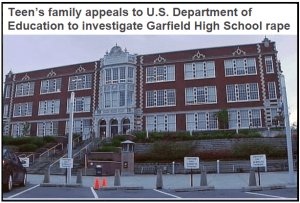
To avoid both liability and accountability, the district disregarded its Title IX obligations and resorted to gender-based discrimination to shut down the sexual assault complaint. By discounting the report, by adopting an inappropriate advocacy role for the perpetrator, and by repeatedly denying the negligence that put female students at risk of sexual assault, the Seattle School District fostered a culture of sexual violence. Subsequently, the survivor’s family filed a complaint with the U.S. Department of Education Office for Civil Rights (OCR), which was opened in June, 2014.
After reporting the assault, the survivor was taken to the nearest hospital and provided forensic evidence. Although the Seattle School District was aware of the assault the same day, it failed to conduct a prompt, thorough, and independent investigation as stipulated by OCR.
The District also failed to involve its Title IX Coordinator as required. Additionally, the district did not protect the survivor from retaliation or inform her of any sanctions meted out against the assailant so she could return to school.
Because the district failed to protect her from a hostile environment, she was unable to return to school and the enriching life she had built there. The loss of her school community, the discrimination and devaluation she faced from the school after reporting the assault, along with disabling PTSD, were traumatic.

Although the application of Title IX in college sexual assault cases appear in the media, many K-12 families often are uninformed about Title IX protections, particularly as they relate to sexual harassment/assault and gender discrimination.
Instead of the Seattle district’s Title IX Officer contacting the survivor’s caregivers to implement Title IX protections, supportive measures, and a safety plan, the family was left to deal with the ensuing chaos. After months of seeking accountability, they turned to the state department of education who instructed the Seattle district to investigate.
Students and families must be educated about sexual harassment, sexual assault, and Title IX so that survivors are better prepared to recognize and respond if harassment or assault occurs—whether in high school or college. School administrators also require education about Title IX and sexual violence, so that they can proactively implement policies and procedures for handling sexual assault complaints.
Unfortunately, as of 2026, OCR has been severely hampered in its ability to investigate complaints. Please see our toolkit, “Ten Things You Can Do When a Title IX Complaint Fails.”
The Motivation to Form Stop Sexual Assault in Schools
After seeing the impact of sexual violence on the survivor and the school community, we were compelled to warn and inform others of the devastation that results when students are assaulted and school districts fail to implement the survivor’s federally-mandated civil rights.